

Reliance Industries 2025 Target Price Analysis
📊 Explore Reliance Industries' 2025 target price with detailed analysis of finances, strategies, market trends & risks to guide your investment choices.
Edited By
George Foster
Dogecoin, initially created as a fun alternative to Bitcoin, has grown into a major player in the cryptocurrency market. Understanding its target price—that is, the price level investors and analysts expect it to reach—requires a grasp of several influencing factors. These include market trends, investor sentiment, technical indicators, and wider economic conditions.
Market dynamics for Dogecoin often respond to hype driven by social media and celebrity endorsements, making traditional valuation methods less reliable. For instance, tweets by prominent personalities can trigger sharp price movements either upwards or downwards in short spans.
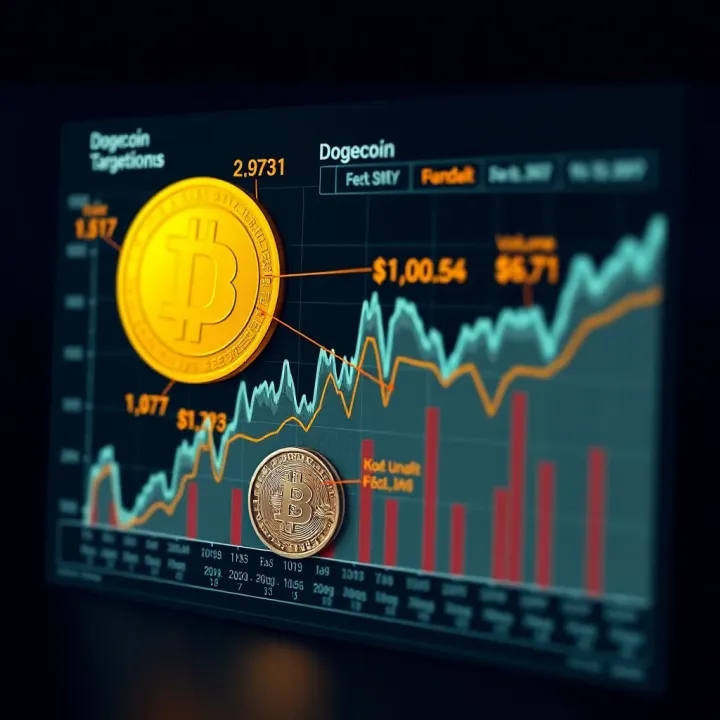
Investors generally use a mix of technical analysis and fundamental analysis to forecast Dogecoin’s price. Technical analysis focuses on chart patterns, volume, and momentum indicators like the Relative Strength Index (RSI) or Moving Averages. For example, a crossover of the 50-day and 200-day moving averages, known as a "golden cross," can signal a bullish trend.
Fundamental analysis, on the other hand, examines the underlying factors such as network activity, adoption rates, and technological upgrades. Although Dogecoin lacks the complex use cases of some cryptocurrencies, growing acceptance for payments and trading boosts its perceived value.
Experts also add value by combining these approaches and weighing in on external factors such as regulatory developments in India and worldwide, which often affect sentiment and capital flows.
Setting a Dogecoin target price isn’t just about charts or hype—it requires weighing volatile market sentiment and underlying technology alongside broader economic conditions.
In summary, understanding Dogecoin's target price involves looking beyond simple numbers to a blend of technical, fundamental, and sentiment-based factors. Traders and investors should continuously monitor these aspects and remain cautious of the risks inherent in such a speculative asset.
Understanding Dogecoin's background and its price behaviour lays the foundation for grasping how target prices are set and forecasted. For traders and investors, knowing where Dogecoin comes from, who drives its demand, and how it reacts to market events can be the difference between informed decisions and guesswork. This section breaks down key aspects that influence Dogecoin's valuation.
Dogecoin started as a light-hearted cryptocurrency in 2013, inspired by the Shiba Inu dog meme popular in internet culture. Unlike Bitcoin, it was created with a focus on simplicity and a fun community rather than being a serious financial asset initially. Over time, though, this digital currency gained a surprisingly strong following. Its evolution includes moments where it transitioned from a novelty coin used mainly for small online tips and donations, to becoming part of broader crypto discussions and trading strategies. For example, in early 2021, a spike in social media buzz and celebrity support, including endorsements by Elon Musk, propelled Dogecoin into mainstream attention and led many investors to re-evaluate its worth.
Dogecoin’s price history is marked by sharp rises and falls, a hallmark of high volatility. Unlike traditional assets, the factors affecting Dogecoin’s value are often unpredictable — social media trends can send prices soaring overnight, while regulatory news may cause sudden drops. Its price climbed from being almost worthless to around ₹40–₹50 per coin at its 2021 peak, showing how sentiment-driven the cryptocurrency is. Such swings highlight the risks but also opportunities for traders ready to navigate this turbulence. Recognising these patterns helps in setting realistic target prices; for instance, assessing past resistance levels or price spikes driven by influencer tweets rather than just fundamental data.
When dealing with Dogecoin, understanding its price movements isn’t just academic — it’s practical insight that helps you anticipate market shifts and plan your trades better.
Overall, diving into Dogecoin’s origins and tracking its dramatic price changes equips investors and analysts with the context needed to make sense of forecasts and price targets discussed later in this article.
Setting a target price in cryptocurrency helps investors plan their trading or investment strategies more effectively. Unlike a mere guess, a target price represents an estimated value that an asset like Dogecoin might reach based on analysis of various market factors. Understanding this concept can aid traders in deciding when to enter or exit positions without acting on impulse.
A target price is essentially a benchmark used by investors to gauge potential gains or losses on an asset. For instance, if Dogecoin is currently trading at ₹30, an investor might set a target price of ₹50 as their goal to sell. This price isn't random; it usually comes from studying past trends, market demand, technical indicators, or expert forecasts. The target price guides investors to stay focused rather than chasing every market move, helping with disciplined decision-making.
Imagine an investor who sets their target price too high without sufficient analysis; they might miss the chance to exit at a profitable point. On the other hand, a well-researched target price can allow securing gains before a sudden market swing. Therefore, the target price acts as a financial roadmap, helping investors avoid emotional decisions and stick to their investment plans.
Market price is the current value at which Dogecoin trades on exchanges. It fluctuates constantly due to supply and demand, news, or broader market sentiments. In contrast, a target price is a future projection, a goal based on analysis rather than the real-time price.
For example, Dogecoin's market price might jump from ₹30 to ₹35 within a few hours. However, an investor’s target price set at ₹50 remains unchanged unless re-evaluated. While the market price reflects immediate conditions, the target price helps plan long-term or medium-term moves.
It is crucial to remember that market prices can be volatile and influenced by short-term events, whereas target prices depend on research and often factor in fundamental and technical insights. Thus, investors should avoid confusing a sudden market price surge with their target—a target price provides a clearer, more strategic aim.
Remember, a target price helps maintain investment discipline and prevents knee-jerk reactions to daily price swings. It’s your compass in the fast-moving crypto market.
In summary, understanding target prices versus market prices equips investors with a structured approach, helping avoid guessing games while trading Dogecoin or other cryptocurrencies. Recognising these differences forms the foundation for effective investment decisions and better risk management.
Understanding what drives Dogecoin's target price is key for anyone interested in trading or investing in this cryptocurrency. Several factors come into play, shaping its valuation and potential price movements. By keeping an eye on these, traders and investors can better gauge realistic target prices and prepare for market shifts.
The price of Dogecoin, like any asset, depends heavily on demand and supply. When more people want to buy Dogecoin than sell it, the price tends to rise. Conversely, if selling pressure increases, prices drop. For instance, during periods of heightened interest, such as when new use cases or partnerships emerge, demand spikes, pushing the price up. On the other hand, a surge in sellers, say after a profit booking wave, can lead to sharp declines. Liquidity also plays a role—low liquidity can cause more price swings, as even modest trades impact the market.
Advancements in Dogecoin’s technology or network upgrades can influence investor confidence and price expectations. For example, improvements that reduce transaction times or fees make Dogecoin more practical for day-to-day use, attracting more users. Conversely, delays or issues in implementing upgrades can cause uncertainty and drag down the target price. Keeping track of planned forks, software updates, or integration with other platforms reveals how the ecosystem evolves, which tends to impact market sentiment.
Dogecoin’s price moves are notoriously affected by social media buzz and endorsements from popular figures. Tweets from celebrities, especially well-known personalities in tech or entertainment, can create sudden spikes in interest and demand. Elon Musk’s past tweets about Dogecoin, for instance, have led to notable price surges. However, this effect can be fleeting; hype-driven rallies often face swift corrections. Investors should be cautious not to base target prices solely on social trends but consider these influences as part of a broader assessment.
The regulatory climate shapes how Dogecoin is perceived by investors and institutions. Positive signals, such as a clear regulatory framework that recognises cryptocurrencies, can increase trust and boost prices. Conversely, restrictions or bans—such as those reported in some countries against crypto trading—can reduce market access and depress prices. Investors should watch for announcements from regulators like the Securities and Exchange Board of India (SEBI) or news about taxation policies, as these can quickly alter market expectations and target prices.
Keeping a close watch on these factors helps investors set more accurate Dogecoin target prices and avoid surprises in an otherwise volatile market.
Estimating Dogecoin's target price involves a mix of technical tools, market fundamentals, and expert views. These methods help investors understand likely price movements and set realistic expectations. Using a balanced approach can reduce surprises caused by the cryptocurrency's notorious volatility.
Moving Averages smooth out price data to identify trends over a set period. For instance, a 50-day moving average shows the average closing price over 50 days. When Dogecoin's price crosses above this average, it might suggest upward momentum; crossing below may indicate a downturn. Traders often combine multiple moving averages, like the 50-day and 200-day, to spot "golden crosses" or "death crosses" which hint at strong price shifts.
Relative Strength Index (RSI) measures whether Dogecoin is overbought or oversold by comparing recent gains and losses over 14 periods. An RSI above 70 suggests the coin may be overbought and due for a correction, while below 30 indicates it could be oversold and ripe for a bounce. RSI works well alongside other indicators because it flags potential trend reversals, helping traders time entries and exits better.
Fibonacci Retracement uses horizontal lines at key Fibonacci levels (23.6%, 38.2%, 50%, 61.8%) to indicate where Dogecoin's price might find support or resistance after a move. For example, after a strong rally, prices often pull back near these levels before continuing upward. Traders watch these zones to set stop-loss or profit targets, making Fibonacci retracements useful to predict price corrections or rebounds.
On-chain Metrics include data like active addresses, transaction volumes, and miner activity recorded on Dogecoin's blockchain. A rising number of active users often indicates growing interest, potentially pushing the price higher. Similarly, larger transaction volumes can signal stronger market participation. These metrics give insight beyond price charts, showing the actual usage and health of the Dogecoin network.
Investor Confidence reflects how market participants feel about Dogecoin and broader economic factors. Social media trends, search volumes, and news coverage influence this sentiment. For example, a celebrity endorsement or a surge in online chatter can boost confidence temporarily, driving up demand and price. Monitoring these signals helps investors gauge market mood, which often precedes price moves.
Broader Crypto Market Trends play a role because Dogecoin rarely moves in isolation. Major shifts in Bitcoin or Ethereum prices often ripple through altcoins like Dogecoin. Regulatory news or macroeconomic events affecting crypto markets impact investor behaviour across the board. Staying aware of these trends helps position Dogecoin's target price within the bigger crypto ecosystem rather than just isolated movements.
Experts combine technical and fundamental analyses with proprietary models to forecast Dogecoin's price. Though not foolproof, these predictions provide a benchmark based on historical data, market conditions, and sentiment analysis. Investors should use them as one of several tools, cross-checking forecasts with real-time data and personal risk tolerance.
Understanding these diverse methods empowers traders to craft informed target prices for Dogecoin, navigating its ups and downs with greater confidence.
Setting a target price for Dogecoin requires carefully weighing certain risks and considerations. Without recognising these factors, investors may end up with misguided expectations or severe losses. Understanding the main risks preserves capital and improves decision-making.
Dogecoin is known for its sharp price swings. Unlike traditional stocks, its value can vary wildly within a day. For example, Dogecoin jumped from around ₹5 to ₹30 within a couple of months during early 2021, driven largely by hype and speculative interest. This volatility means the target price can quickly become obsolete.
Besides natural volatility, Dogecoin's market remains vulnerable to price manipulation. Large holders, often called "whales," can cause rapid price moves by selling or buying significant quantities. In March 2021, coordinated social media campaigns amplified such swings, misleading retail investors. Hence, investors setting target prices should consider these risks and avoid relying solely on short-term price movements.
Prediction models, including technical and fundamental analysis, help in estimating Dogecoin's target price but they come with inherent limitations. Technical indicators depend on past data and may fail when market conditions shift, such as during unexpected regulatory announcements or macroeconomic shocks.
Fundamental analyses for Dogecoin are also tricky since it is mostly a meme cryptocurrency with fewer intrinsic utilities compared to coins like Ethereum or Bitcoin. This makes forecasts more speculative. For instance, using on-chain metrics alone without accounting for social trends or market sentiment can lead to unrealistic targets.
Always remember, no model guarantees accurate predictions, especially in crypto markets where emotions and external factors play a major part.
Relying solely on Dogecoin or setting aggressive target prices can expose an investor to high risk. Diversification across different cryptocurrencies, including stablecoins and established coins like Bitcoin, helps manage this risk better. It smooths out volatility impacts and reduces dependency on any single asset's price performance.
Besides crypto, traditional asset classes such as equities, fixed deposits, or gold can form a balanced portfolio. Diversifying also protects investors from sudden downturns or regulatory changes that might hit Dogecoin specifically.
In sum, while setting a Dogecoin target price is useful, it must be paired with awareness of market turbulence, realistic model expectations, and a diversified approach to keep risks in check.
When investing in Dogecoin, setting a target price is more than just picking a number. It requires understanding the market trends, managing risks, and staying alert to news that can sway prices sharply. Practical tips help investors avoid common pitfalls and make choices based on informed reasoning rather than hype or guesswork.
It's easy to get carried away by sharp price spikes or celebrity endorsements, but setting realistic expectations helps prevent disappointment and impulsive decisions. Investors should analyse recent market behaviour, such as Dogecoin’s price rallies or dips alongside Bitcoin or Ethereum movements, to get an idea of possible short-term volatility.
For example, if Dogecoin historically jumps 30% after certain events but then drops by 20%, setting a target price expecting a 100% gain may be unrealistic. Tracking the coin’s average growth over specific periods, like weekly or monthly trends, lends perspective. Also, considering wider crypto market conditions, like overall bullish or bearish phases, tends to create a better picture of what’s reasonable.
Practical investors use stop-loss and take-profit orders to protect their investments. A stop-loss order automatically sells Dogecoin when it falls to a certain price, limiting losses if the market turns sour. Conversely, a take-profit order locks in gains by selling once the price hits your target.
Consider an investor who buys Dogecoin at ₹100 and sets a stop-loss at ₹90 to cap losses and a take-profit at ₹130 to secure profits. This method avoids emotional decision-making during sudden price swings. Such orders are straightforward to place on most Indian cryptocurrency exchange platforms like WazirX, CoinDCX, or CoinSwitch Kuber.
Dogecoin's price is sensitive to various external factors, including news and regulations impacting cryptocurrencies. Staying informed about updates from authorities like the Securities and Exchange Board of India (SEBI) or announcements from global stakeholders can shape your trading strategy significantly.
For instance, news about government discussions on crypto taxation or usage restrictions have in the past swung crypto prices sharply. Similarly, tweets or statements from influential figures often cause immediate price movement. Hence, following trusted news sources and regulatory bulletins enables investors to adjust their targets and strategies promptly.
Keeping your ear to the ground helps you anticipate market shifts rather than react after the fact.
In summary, building practical habits like realistic target setting, using automated trading tools, and monitoring key news will help investors navigate Dogecoin’s ups and downs safely and efficiently.
📊 Explore Reliance Industries' 2025 target price with detailed analysis of finances, strategies, market trends & risks to guide your investment choices.
📈 Explore key factors influencing Reliance's share price target for tomorrow including market trends, analyst insights, and economic updates for smarter investing decisions.

📈 Explore where Reliance Industries Limited (RIL) stock could head by 2025. Analyze business shifts, market trends, and expert views to guide your investments wisely.
📈 Explore Ripple XRP's latest price trends, expert insights, and key market moves to watch. Stay informed on regulation impacts and future outlooks.
Based on 5 reviews